Vedanta Press and Catalog
  

View Cart

free reading materialnewslettercontact us

home

info on vedanta

browse catalog

new titles

on sale

contact us

for the trade

virtual catalog


Interpreting_Ramakrishna.jpg

Interpreting Ramakrishna
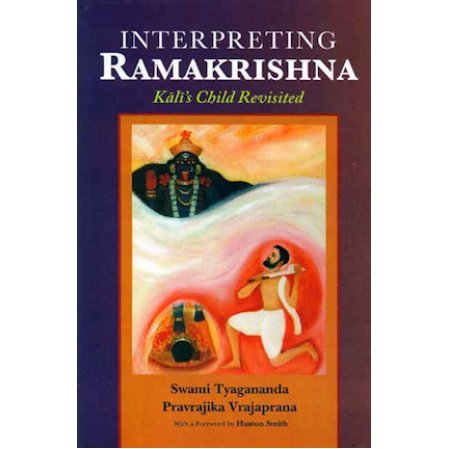
by Swami Tyagananda
and Pravrajika Vrajaprana


Interpreting Ramakrishna: Kali's Child Revisited is a scholarly rebuttal to the controversial book Kali's Child, which asserted that Sri Ramakrishna's mystical experiences were fueled by homoerotic desires that he neither accepted nor understood. A big part of the author's problem is that he could barely read and understand Bengali, the language of the source material. Furthermore, he unfortunately was too eager to prove conclusions that the literature didn't support.

These and other points are explained step-by-step by the authors.

Included in Interpreting Ramakrishna is a lengthy analysis of scholarship on Sri Ramakrishna over the past century.

According to Harvard professor Francis X. Clooney: "Interpreting Ramakrishna is a substantial and conscientious work of scholarly and religious reflection, the best resource we have for understanding Sri Ramakrishna today."

Professor Gerald James Larson (UC Santa Barbara) says that Interpreting Ramakrishna "is balanced, scrupulously fair, and generous to all sides in the debate."

According to Professor Anantanand Rambachan, Interpreting Ramakrishna "is a patient and elaborate illustration of the possible This is a welcome contribution to Ramakrishna that treads the uncommon middle ground between the extremes of the uncritical insider and the unexamined assumptions of the scholar."

(We are selling this book at a much reduced price due to a special purchase. The Amazon price is $92.00).


410 pages Indian hardback    $39.95
(retail only)

Customer Reviews:

Global Rating: 4.62 from 8 reviews.

Add your own review for this product

Rating
Name
City / State / Country
Date
—Pico Iyer, author of The Open Road US Jan 19, 2011
  "Interpreting Ramakrishna is a tour de force of analytical clarity,
scholarship, wisdom and even-handedness. For those of us who know all
too little about Ramakrishna, it is clearly both the ideal introduction
to his being and message and the last word. Would that more books on
such elusive spiritual subjects had such rigor, such devotion and such
judiciousness!"
—Pico Iyer, author of The Open Road
Michael Mccarthy New York ny US Nov 8, 2010
  I found the authors writing and research excellent.To be honest
I have little interest in Kali'Child.
I thought it was a poor book with a cultural bias but I found the authors examination of the uncritical acceptance of it in the west very helpful.They are pointing to an academic and psychological blindness that is still with us.
Anonymous Nov 10, 2010
  Magisterial in scope and depth, this book will be welcomed by devotees who may have been disturbed by the interpretation of Sri Ramakrishna presented in Jeffrey Kripal's book "Kali's Child." Swami Tyagananda and Pravrajika Vrajaprana touch all the bases in their thoroughgoing, point-by-point rebuttal.

Their discussion of problems of translation and interpretation, especially in cross-cultural contexts, should be heeded by anyone concerned about intercultural misunderstanding.

The book also features a concise but comprehensive survey of the literature on Sri Ramakrishna from 1878 down to the present--very useful for those of us who missed some of it.


Jyotirmoy Bhattacharjee New Delhi De IN Nov 15, 2010
  An individual's religious pursuit is not an objective exercise visible to the outside world. It is an individual's internal journey performed alone in solitude and silence. And that journey has unique contours for every individual on that road. In the West there is a persistent anxiety to analyse the religious experience; yet howsoever it may examined, it can never reveal what the individual performing the journey experienced. Scholars on the subject are not interested in God or in how to reach Him; their interest lies in analyzing how another individual undertook that journey to God. With what authority can these scholars accept or reject the result of that journey? And what is the use of the analysis? The message of Ramakrishna stands out in its simplicity: unless one tries out what he recommends and discovers its truth or how it is false, there is no point in belittling Ramakrishna.
Charles Feldman Providence RI US Jan 15, 2011
  This is a great book, which thoroughly refutes all the mistranslations and innuendoes in Kali's Child. I was talking to Swami Tyagananda, complementing him on the thoroughness of the research, and he told me he had been researching it for ten years. It shows.
Ganapati Shivananda Durgadas Albany Ne US Jan 17, 2011
  A superb, well-balanced rebuttal to Kripal's questionable Kali's Child. I read the latter almost immediately when it was first published, and came away from it curious and dissatisfied with the manner of how Kripal came to his conclusions. The authors provided well-documented substance to my doubts, and now leads me to question Kripal's original intentions. Furthermore, it confirms my suspicions about nonHindu 'scholars' of HInduism, who all too often exploit the Sanatana Dharam for their own careerist and/or sociopolitical advantages.
Anonymous Cambridge MA US Jan 8, 2011
  "Interpreting Ramakrishna" is grounds for sadness and tremendous hope.

Let's get the sadness out of the way, since this book is a tour de force. Swami Tyagananda had already written about Kali's Child in "'Kali's Child' Revisited - or -Didn't Anyone Check the Documentation." At the heart of this second book is an examination of the primary source documents in the life of Sri Ramakrishna. All of them had been available, unexpurgated, in their original language (Bengali), for about a century. Kripal asserted that there was a secret teaching, exposed for the first time in his books. His sources for this claim? Those very same Bengali documents, most of which lie next to the bed of every monk and nun of the Ramakrishna and Sarada Orders, not to mention many lay devotees.

Ridiculous as his claim might sound when laid out this way, fellow academic practitioners swallowed it hook, line and sinker. A big source of readers' sadness in the book will stem from the comprehensive, painstaking account of exactly how the book became popular and "authoritative."

The story told in "Interpreting Ramakrishna" is horrifying to anyone who has been associated with a major research university: a young man was able to get a doctoral dissertation approved at the University of Chicago, one of America's foremost research universities, without having scholarly proficiency in the language that the key documents of his dissertation were written in. His dissertation advisors, the first line of defense against the publishing of fraudulent work, failed to notice.

But what came after was much worse, albeit predictable in retrospect: a domino effect. For once Kripal's dissertation received the stamp of approval from a prestigious university and its gatekeeping professors, it would, naturally, find an equally prestigious publisher. Then the reviews started coming in. A handful of scholars (particularly the one or two who actually knew Bengali) raised serious concerns about the work. But others, unaware that the texts had been inaccurately, often deceptively, translated, were ecstatic at the publication of a provocative work whose discoveries regarding Sri Ramakrishna's life were heretofore beyond imagining.

But imagined Kripal's stories were. And a large section of the book is devoted to a refutation of every false claim in Kripal's book. It is exhaustive, and exhausting, mostly because the authors, one senses, feel it must be. It's almost as if they fear that, like a monster in a horror film, any detail left unattended might regenerate, forcing them into the unpleasant task of writing a sequel.

One of the simplest and most important contributions of the authors is a stake through the heart of the "hidden teachings of Sri Ramakrishna" meme. This portion of their project, incidentally, has been made available, for free, at InterpretingRamakrishna.com: a full translation of the few pages in the original Bengali Kathamrita that weren't translated into English in 1942.

The excisions, it turns out, stemmed from original translator Swami Nikhilananda's awareness that they were either too culturally alien or would offend *American* sensibilities, still puritanical at the time. The truth, in other words, was the precise *opposite* of Kripal's claim. For how could Indians be too squeamish to handle texts that had been printed and reprinted in Indian languages, unedited, decades before the British left?

And indeed, one of the key purposes of the book is to reclaim not only Sri Ramakrishna but the entire academic discipline of Hindu studies from the Orientalism that has been foisted upon it by many scholars, even well intentioned ones.

But there are grounds for great hope here as well. Obvious scholars themselves, the authors' beef isn't against honest, fearless, rigorous academic examination of Sri Ramakrishna and his life. Bring it on, they argue. Use a Freudian lens if you want to. Just be fair, and for God's sake, know the language that you're writing about. That kind of attitude is refreshing, and all too rare. Hinduism is hardly the only religion whose practitioners would benefit from this kind of openness to rigorous scholarship.

Many of the attacks on "Kali's Child" by actual scholars of and believers in Sri Ramakrishna's life were based on genuine outrage. However, many of the most vocal protagonists in the drama that ensued its popularization in India were people who had read neither Kripal nor Sri Ramakrishna. They knew only that a Hindu saint had been unfairly maligned. True! But underlying their own claims was a deep homophobia, founded on an ahistorical Victorianism that has permeated Hinduism (and large parts of Islam) since the days of British colonization.

My greatest fear about this project wasn't that it wouldn't set the record straight--I had no doubt that the authors, both well known for the rigor and lucidity of their writing, would acquit themselves well. It was, rather, whether they could walk a different kind of razor's edge: defending Sri Ramakrishna from Kripal's craftily politicized scholarship without hitting sociological landmines.

And this is where Sister Vrajaprana, a monastic disciple of the monk who was Christopher Isherwood's own spiritual guide, and Tyagananda, a chaplain to students at Harvard University, truly rise to the challenge. They do justice to Ramakrishna's breadth and universality by discussing not only the issue of homosexuality but by recognizing the existence and experience of gay devotees of Sri Ramakrishna, including onetime biographer Isherwood and Ashok Row Kavi. And never, even once, do they resort to the homophobia that would have sullied the book in the eyes of today's Western intelligentsia... and tomorrow's India.

We owe Swami Tyagananda and Pravrajika Vrajaprana a debt of gratitude. They have held academic scholars of Hinduism to a higher standard. They have blown a hole through a book founded on a dissertation that should never have passed muster. And they have done so in a way that upholds the highest, most hopeful principles of a religion that is, at its best, the world's broadest and most tolerant.
Srinivas Gandhi Cambridge MA US Nov 9, 2011
  Tyagananda and Vrajaprana do vigorously contest Jeffrey Kripal’s Freudian misinterpretation of Sri Ramakrishna in Kali’s Child. Their book, however, is far greater in scope, pointing to larger issues in cross-cultural studies and situating Ramakrishna studies within that context. With regard to Kripal, however, the critique is far more fundamental and devastating than Goldberg allows: They allege that Kripal barely knew Bengali, the language of the original source material referenced in his book, and that his mistranslations were employed, deliberately and erroneously, in support of a questionable theory. Even more disturbingly, since most of them were ignorant of Bengali, reviewers and Hindu studies scholars simply assumed that the translations were accurate. They would proceed to celebrate the book’s “discoveries,” giving the book near-canonical status despite the fraud underlying it.

An emerging concept in media studies is that of “fairness bias”: the notion that, when there are two sides, objectivity lies in presenting both sets of arguments, the “truth” lying somewhere in the middle. While its presence is most familiar to frequent viewers of cable news, one expects better of a more elite forum like the LARB. There is nothing wrong with choosing “someone who stands outside both traditional religion and academia” to review a book that critiques religious scholarship, so long as he or she is capable of evaluating its claims. While Goldberg might well be, there is no evidence of it in this piece.

Instead, using abilities that are admittedly far more impressive than the mere knowledge of Bengali, Goldberg first clears Kripal of racism and cultural imperialism and then absolves Vrajaprana and Tyagananda of fundamentalism and homophobia. He then goes on to tackle the issue of mistranslation, concluding that, “To the lay reader, each side can sound convincing on these issues of textual fidelity” and that “the larger issue is the ambiguity of translation itself.”

We can all agree that this is a “larger issue,” and that “a lay reader” can’t examine competing claims. That is the very purpose of the book reviewer: someone competent who can sort through claims and provide analytical perspective. Otherwise, one could have Nancy Grace or Dr. Phil review Elaine Pagels’s next work. Interpreting Ramakrishna’s claim, after all, is that Kripal’s translations are wrong, as in inaccurate, not merely slightly different interpretations. If I may be so bold as to use the example of fruit among Freudians, this isn’t “I say ‘po-tah-to,’ you say ‘po-tay-to.’” It’s “I say ‘potato’, you say ‘pineapple’.”

To take a minor, less controversial example, Kripal turns “Time (kala) is Brahman. One who sports with Time is Kali, the Primal Power! She moves the Unmovable” into “Kali is Brahman. She who has sex with Siva is Kali, the Primordial Power! She arouses the Unmoving.” Here kala, incontrovertibly, means time. How did it become the proper name of a deity Kali? How did Siva and a sex act even enter a translation when neither appeared in the original? This is not about “a boatload of assumptions.” It is not even about an instance of textual ambiguity where reasonable people can disagree and which can be the focus of a productive academic exchange. Rather, Kripal’s translation, here and on countless other now documented occasions, is flat out incorrect.

As a well regarded scholar in Christian historical and literary studies told me recently, “Theorists have to do their philological homework. Have they learned the original languages? Once they have, they can use any interpretive framework they wish. But not otherwise.”

The Carnegie Endowment for International Peace predicts that by 2050, India will rank 3rd in world GDP. The increasing penury faced by American humanities faculties (already evident now) and increasing wealth of Indian philanthropists practically assure us that American universities will soon place a far greater emphasis on South Asian studies. The consequent increase in scholarly competition, coupled with a change in universities’ financial incentives will, on their own, will inevitably result in more serious scholarship. Therefore, I have little doubt that Kripal’s work will ultimately be seen as a footnote in the history of religious studies.

But while Kripal’s work may be a blip, it is also a blot. Future intellectual historians will hardly be dumbfounded that a scholar sought fame through trendy mistranslations. Fads and ambitious young up-and-comers are, after all, the nature of scholarship in every field, including the sciences. They will, however, be amazed that a fraudulent translation was swallowed hook, line, and sinker by Kripal’s fellow scholars and by the major publishing houses they themselves policed.

Vrajaprana and Tyagananda are correct to state that there is nothing wrong with any academic approach to religion, so long as it is rigorous. One would have high methodological and philological expectations of a scholar who wished to focus on, say, phallocentrism and the Cross, or signs of a torrid affair between St. Francis and St. Claire. Such studies, of course, are the exception rather than the rule among those who study the history of Christianity. One must wonder, then, why exoticism and sexuality are such a major focus for scholars of Hinduism. Future scholars will indeed wonder how this Orientalism writ large remained unchallenged for so very long. And it is they, too, who will recover Interpreting Ramakrishna, recognizing its call for full freedom with rigor as a representation of classic, universal scholarly ideals in a field that had become an academic wasteland.

Goldberg states that “[f]or the millions who continue to draw inspiration from Ramakrishna’s life and work […] the sage’s sexuality — whether conscious or unconscious, acted upon or sublimated, homosexual or heterosexual — is about as relevant as Michelangelo’s or Bach’s.” In the religious world, particularly in religions with monastic traditions that emphasize poverty and chastity, it most certainly matters whether a spiritual teacher’s lived up to his teachings. Marcial Maciel may have founded the Legionaries of Christ and been a favorite of a pope, but he is most unlikely to be beatified at this point in time. There surely is a difference between Michelangelo and St. Benedict, from a religious point of view. To say otherwise is to profess utter ignorance of religious life. Less so, of course, if you believe that Hindus are too ignorant to recognize pedophilia in the founder of a religious order, or are so exotic that they would celebrate it.

Lacking Goldberg’s ability to see into the hearts of others, I can’t say if he read Interpreting Ramakrishna or not. But his effort, however well intentioned, is a great disservice to an important debate. It is my hope that, in the future, the LARB assigns articles on India’s religion and culture with the same degree of seriousness that it would to review pieces on Europe’s or America’s.

home | info on vedanta | browse catalog | new titles | on sale | contact us | for the trade